Introduction
Bisection Method एक bracketing method है, जिसका उपयोग किसी equation का approximate root निकालने के लिए किया जाता है।
इस method का आधार यह है कि यदि किसी interval में function का sign change होता है, तो उस interval में कम से कम एक root अवश्य होगा।
Mathematically condition:
Basic Idea
इस method में हम दिए गए interval को बार-बार दो बराबर भागों में divide करते हैं और उस हिस्से को चुनते हैं जहाँ sign change हो रहा हो।
इस process को तब तक repeat किया जाता है जब तक desired accuracy प्राप्त न हो जाए।
Algorithm (Step-by-Step Procedure)
Step 1:
एक interval चुनें ऐसा कि
Step 2:
Midpoint निकालें:
Step 3:
calculate करें
Step 4:
अब check करें:
- यदि , तो root interval में है
- अन्यथा root interval में है
Step 5:
नए interval के साथ यही process repeat करें
Step 6:
जब तक required accuracy न मिल जाए, process जारी रखें
Example
Equation:
Step 1: Initial interval
मान लें:
,
यहाँ
इसलिए root interval में है।
Step 2: First Iteration
अब
इसलिए नया interval:
Step 3: Second Iteration
अब भी sign change में होगा
नया interval:
Step 4: Continue Process
इसी तरह process repeat करते रहेंगे जब तक desired accuracy न मिल जाए।
Final root लगभग होगा:
Graphical Interpretation
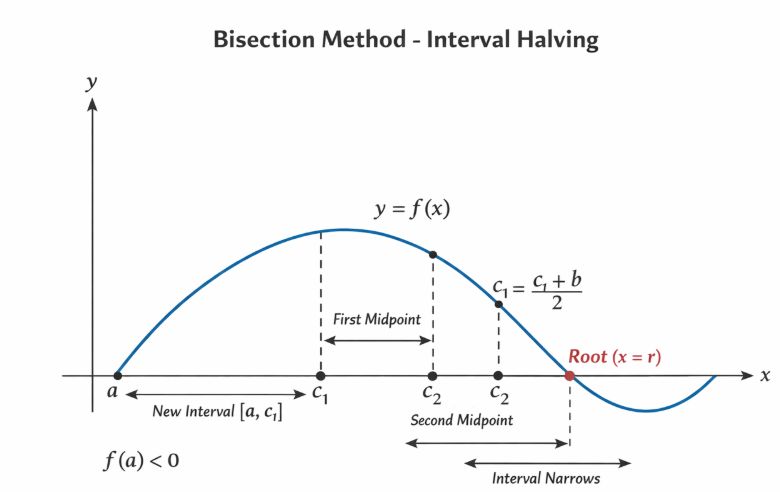
Bisection Method में हम उस point को खोजते हैं जहाँ curve x-axis को काटता है।
हर iteration में interval छोटा होता जाता है और root के करीब पहुंचता है।
Bisection Method – Iteration Table
Equation:
Initial Interval:
Iteration Table
| Iteration | a | b | c = (a+b)/2 | f(c) | New Interval |
|---|---|---|---|---|---|
| 1 | 1.0 | 2.0 | 1.5 | -0.125 | [1.5, 2] |
| 2 | 1.5 | 2.0 | 1.75 | 1.609 | [1.5, 1.75] |
| 3 | 1.5 | 1.75 | 1.625 | 0.666 | [1.5, 1.625] |
| 4 | 1.5 | 1.625 | 1.5625 | 0.252 | [1.5, 1.5625] |
| 5 | 1.5 | 1.5625 | 1.53125 | 0.059 | [1.5, 1.53125] |
| 6 | 1.5 | 1.53125 | 1.515625 | -0.034 | [1.515625, 1.53125] |
Explanation
अब समझो यह table कैसे बना है:
- हर step में midpoint निकाला गया है
- फिर calculate किया गया
- फिर sign check किया गया:
- यदि sign change left side में है → नया interval left
- नहीं तो right
इस तरह interval धीरे-धीरे छोटा होता जाता है
Final Result
कुछ iterations के बाद root लगभग:
Advantages
यह method बहुत simple और easy to understand है
यह हमेशा converge करता है यदि condition satisfied हो
यह reliable method है
Limitations
यह method slow होता है
हर iteration में accuracy धीरे-धीरे बढ़ती है
Derivative का उपयोग नहीं करता, इसलिए fast methods से कम efficient है
Final Understanding
Bisection Method interval को बार-बार divide करके root निकालता है
यह sign change principle पर आधारित है
यह method guaranteed convergence देता है
यह beginner-friendly और exam में बहुत important method है